By Zachary Kimmel (Stanford Law School J.D. ’27)
In 2005, the United Nations designated January 27—the anniversary of the liberation of Auschwitz—as International Holocaust Remembrance Day. Then-Secretary General Ban Ki-Moon urged member states to educate future generations about its history.
Yet in January 2018, on the eve of this observance, the Polish Parliament adopted legislation criminalizing public statements that attributed responsibility for the Holocaust to Poland. Signed into law by President Andrzej Duda, the statute threatened up to three years’ imprisonment for speech referencing individual acts of collaboration or suggesting broader Polish complicity in Nazi atrocities. It even applied extraterritorially to citizens and foreign nationals alike.
Poland’s Holocaust Memory Law should be understood as a part of a broader ideological project overseen by the country’s right-wing Law and Justice Party, or PiS. At its core, the project involved the manipulation of historical memory to entrench a state-approved narrative—the “Myth of Polish Innocence.” The Myth rests on a rather uncontroversial initial observation: few countries suffered devastation to the scale Poland did during World War II. By 1945, a fifth of Poland’s prewar population was dead, Warsaw was rubble, and three million Polish Jews had been murdered, primarily in one of six extermination camps established by the Nazis on Polish soil.
From this history, the Myth makes its foundational claim: Poland is a country of innocent victims, a “Christ of Nations” forced to suffer under German and later Soviet oppression. This righteous victimization, combined with tales of ordinary Poles who risked their lives to save Jews, is what redeems Poland from the humiliation of foreign occupation. Crucially, the Myth asserts that Poland bore no responsibility for the Holocaust. Poland is a nation of victims, and victims only.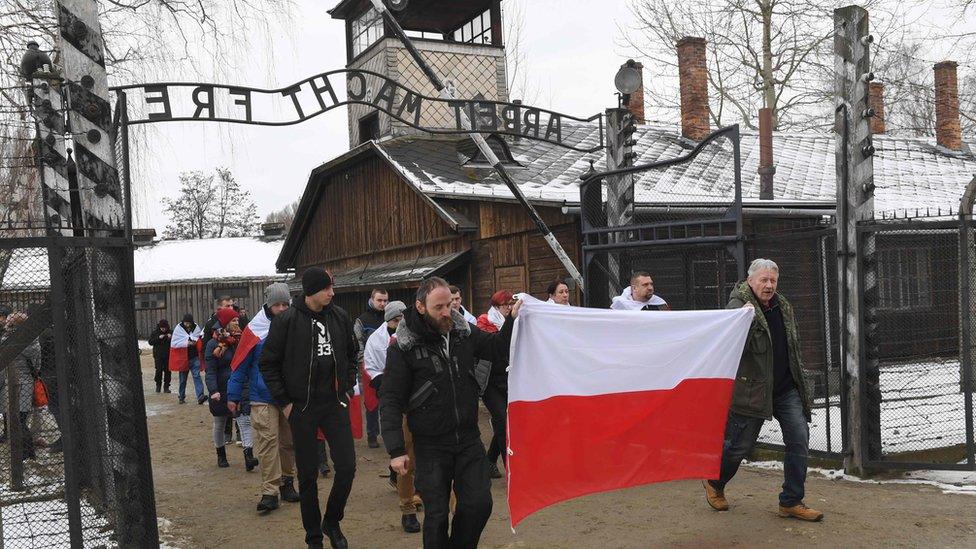
The problem with the Myth of Polish Innocence is that it is deeply ahistorical. The most prominent counterexample is the Jedwabne Pogrom of 1941, in which hundreds of Jews were tortured and burned alive by their Polish neighbors. Jedwabne’s mayor and other municipal officials were instrumental in coordinating the slaughter. The history of Jedwabne was largely unknown before the publication of Jan Gross’s Neighbors in 2000, which documented that the atrocities in Jedwabne were carried out by Polish civilians without coercion by German soldiers.
This scholarship was intolerable to the Polish right. In 2001, Jarosław Kaczyński, co-founder of PiS, denounced Gross’s work as an effort to turn Poles into “Hitler’s associates.” Right-wing activists popularized the phrase “the Jedwabne lie,” framing any discussion of Polish complicity as an attack on national honor.
After PiS’s electoral victory in 2005, the party moved to amend Poland’s penal code to criminalize “accusations of participation in Nazi crimes,” punishable by up to three years’ imprisonment. Commentators dubbed the proposal Lex Gross (Latin for Gross’ Law). Poland’s Constitutional Tribunal on procedural grounds in 2008. The message, however, was clear: even at the cost of blatant revisionism, the state was willing to use criminal law to defend the Myth.
PiS swept back into power in 2015, securing both the presidency and an outright parliamentary majority—the first such majority in post-Communist Poland. With this mandate, the Myth became official policy. The Minister of Education dismissed Jedwabne as a “matter of opinion,” and the head of the Institute of National Remembrance denied Polish responsibility altogether.
In 2018, Parliament passed a memory law closely resembling the 2005 version. Section 55a imposed criminal penalties on anyone who claimed that Poland was responsible for Nazi crimes or who “grossly diminished” the responsibility of the “true perpetrators”—implicitly defined as Germans alone. The law’s extraterritorial reach was striking: Section 55b applied both to citizens and non-citizens alike.
The international backlash was immediate. U.S. officials warned that the law could undermine Poland’s strategic alliances. Israeli leaders condemned the statute as a form of Holocaust denial, emphasizing that countless Jews were murdered “without ever meeting a German soldier.” In June 2018, just five months after its enactment, Parliament surrendered to this immense diplomatic pressure and amended the law to remove criminal penalties. The civil provisions remained intact. This retreat was entirely strategic. During parliamentary debate, far-right lawmakers openly framed the revision as capitulation to Jewish pressure. Prime Minister Morawiecki made clear that the government’s position had not changed: “Those who say that Poland may be responsible for the crimes of World War II deserve jail terms,” he remarked, “but we operate in an international context.” The statutory revision reflected diplomatic necessity, not historical reckoning.
Although the criminal penalties were removed, the revised statute provided a legal infrastructure for disciplining historical speech. Article 53O authorized civil lawsuits to protect Poland’s “national reputation” and permits nongovernmental organizations to sue on the state’s behalf, with damages payable to the state treasury. In effect, the government outsourced civil enforcement to ideologically aligned private actors while still retaining any resulting windfall.
Right-wing legal organizations quickly mobilized. Soon after the law’s passage, the Polish League Against Defamation filed suit against Página 12, an Argentine newspaper, alleging reputational harm from an article discussing Jedwabne. Although the case was dismissed for lack of jurisdiction, more vulnerable defendants soon followed. In February 2021, the League sued historians Jan Grabowski and Barbara Engelking over their research documenting the role of Polish civilians in the Holocaust. A trial court ordered the historians to issue a public apology—a ruling celebrated by the Polish right and condemned by historians as legitimizing Holocaust denial.
In August, a Polish appellate court reversed the Grabowski-Engelking judgment, pointedly observing that “the courtroom is not the right place for a historical debate.” For PiS, however, the courtroom is precisely the place to adjudicate these historical controversies. Even unsuccessful lawsuits can function as a tool of intimidation and chill scholarship. Legal process itself becomes a mechanism for policing the past.
All this brings helps explain why authoritarian regimes gravitate toward historical memory and what motivates autocratic efforts to distort the past. At bottom, history poses a unique threat to authoritarian rule because it is inherently pluralistic. Serious scholarship recognizes multiple perspectives and treats citizens as equal contributors to a national narrative. Democracies can tolerate this multiplicity; authoritarian regimes cannot. Instead, illiberal governments seek to impose a single, cohesive national story. History under fascism, therefore, is mythical and static, rather than dynamic and contested.
The Polish case illustrates this dynamic with particular clarity. PiS’s memory policy constructs a coherent but inaccurate mythology that vindicates non-Jewish Poles as blameless victims. In a democratic society, narratives of Polish suffering could coexist with evidence of Polish complicity. Under Poland’s illiberal regime, however, scholarship that disrupts the Myth is treated as a threat to the nation itself. Competing historical narratives are transformed from alternative interpretations into acts of subversion.
Ultimately, international pressure forced Poland to abandon criminal sanctions, and rigorous scholarship continues to expose the gaps in state-imposed memory. Law can discipline historical discourse, but it cannot fully control it.